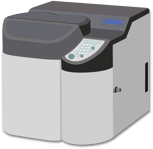
500 Series Ultra-Fast Gas Chromatograph
One GC. Three modes. Up to 10x faster analysis.
The 500 Series GC delivers conventional, fast, and ultra-fast chromatography. In one compact instrument, without the cost, footprint, or complexity of running multiple systems.
More samples. Less waiting.
Most GC systems run one mode. The 500 Series runs three.
The 500 Series removes that choice. It runs all three modes: conventional, fast, and ultra-fast, on the same instrument. When you need throughput, switch to Ultra-Fast mode and process 5 to 10 times more samples in the same working day. When your method demands conventional analysis, that option is always there.
For lab managers, that means one capital purchase covers what would otherwise require multiple instruments. For analytical scientists, it means the method drives the decision, not the hardware.
Where the 500 Series fits
The 500 Series fits laboratories where GC throughput is a limiting factor. High-throughput testing environments, production and process labs, and facilities running multiple methods on a single system all benefit from faster cycle times and a flexible operating mode.
- High-throughput testing labs: Large sample volumes, and the GC is the bottleneck. Ultra-fast mode increases daily throughput without adding bench space or capital equipment.
- Production and process environments: Turnaround time is a factor in operational decisions. Faster results reach the people who need them sooner.
- Labs running multiple methods: Different analyses, one instrument. Switch between conventional, fast, and ultra-fast modes depending on the method.
- Managing backlog or outsourcing: If samples are queuing or going out of house, shorter cycle times change the economics.
Why ultra-fast GC matters
In a typical lab, a single GC run can take 20–30 minutes from injection to result. Multiply that across a day's worth of samples and the instrument becomes the ceiling on everything else.
-
GC is often the slowest step in the process
When each analysis takes 20–30 minutes, the number of results you can produce in a day is fixed — regardless of how efficient everything else in the workflow is.
-
Cool-down time adds up
In conventional GC, the oven needs to return to its starting temperature between runs. That dead time happens after every single sample, and in a busy lab it accumulates quickly.
-
Faster heating. Faster cooling.
In ultra-fast mode, the 500 Series passes an electrical current directly through the column rather than heating the whole oven. The column heats and cools far faster than an oven chamber, cutting both run time and the dead time between runs. In some methods, cycle times drop from 25–30 minutes to just a few minutes.

-
More samples. Same instrument.
Ultra-fast mode means more analyses in the same working day without adding bench space or capital equipment. The 500 Series can process 5 to 10 times more samples compared to a conventional GC.
Built around your workflow
Oven
The 500 Series uses a flow-through oven with a built-in heat exchanger. Air circulates around the column during the run, and heat from the outgoing air is fed back into the incoming stream. At the end of a run, cool air bypasses the exchanger and the oven temperature drops quickly.
Ultra-Fast Mode
In ultra-fast mode, an electrical current runs directly through a deactivated stainless steel column, heating the column rather than the oven. This allows faster temperature ramping and significantly shorter cool-down times compared to conventional air-blown heating.
Injector
The injector is temperature-programmable and supports split and splitless operation. It can reach 600 °C, ramp at up to 720 °C/min, and has 10 programmable ramps. For the analytical scientist, that is a lot of control over what happens before the sample ever reaches the column.
Column
The 500 Series takes standard capillary columns from most manufacturers, as well as packed columns. Ultra-fast mode requires deactivated stainless steel columns, which are now available for most common applications.
Detectors
The choice of detector defines what the 500 Series GC can measure. Selecting the right detector allows the system to be configured for specific compound classes and analytical methods. In many cases, one detector can be used across several related applications, depending on the compounds of interest.

Flame Ionisation Detector
Used for:
Alcohols, hydrocarbons, solvents, and other organic compounds.
The FID is a general-purpose detector widely used for routine organic analysis. It gives a stable, repeatable response across a wide linear range, which makes it reliable for methods where consistent quantification matters.
Common applications include alcohol analysis, solvent measurement, and general quality control testing.

Electron Capture Detector
Used for:
Halogenated compounds and other electronegative species.
The ECD is a high-sensitivity detector suited to trace-level analysis of compounds that readily capture electrons. It is often used where low detection limits are required.
Typical applications include environmental contaminants, halogenated solvents, and regulated trace compound analysis.

Thermal Energy Analyser
Used for:
Nitroso, nitro, and other nitrogen-containing compounds such as nitrosamines.
The TEA is a selective detector designed specifically for nitrogen-specific analysis. When fitted to the 500 Series GC, it allows targeted measurement of nitrosamines and related compounds where high selectivity is needed. It is the detector of choice for nitrosamine testing in food, cosmetics, pharmaceuticals, and tobacco.
Built for labs that can't afford to slow down.
The 500 Series GC is used in pharmaceutical quality control, cannabis testing, food analysis, and forensic laboratories where sample throughput and turnaround time are operational priorities.
How the 500 Series compares
The 500 Series removes the tradeoff between analysis speed and method flexibility.
| 500 Series GC | Conventional GC | |
|---|---|---|
Analysis modes |
Three (conventional, fast, ultra-fast) |
Conventional |
Minimum analysis time |
5 min (Ultra-Fast mode) |
30 min |
Size |
45 × 22 × 57 cm |
50 × 58 × 54 cm |
Weight |
18 kg |
45 kg |
Power consumption |
1,200 VA |
2,950 VA |
Throughput |
Scalable |
Fixed |
Choosing the right system
Ellutia makes two gas chromatographs. The 200 Series is built for routine testing in smaller or teaching environments. The 500 Series is built for labs where throughput, speed, or flexibility are the deciding factors.
| 500 Series GC | 200 Series GC | |
|---|---|---|
Primary focus |
High throughput |
Routine testing |
Operating modes |
Conventional, fast, ultra-fast |
Conventional |
Speed |
Ultra Fast |
Conventional |
Footprint |
Compact |
Very compact |
Best suited to |
High sample volumes |
Straightforward, regular workflows |
Software control
The 500 Series GC is controlled using Ellution, Ellutia's chromatography data station developed in conjunction with DataApex. Ellution handles instrument control, data acquisition, and results processing from a single interface.
It connects to a wide range of data acquisition hardware and can run alongside other gas and liquid chromatographs in the same lab. A single workstation can control up to four instruments. Optional extensions are available for specific analytical methodologies.
Ellution is CFR compliant, making it suitable for use in regulated laboratory environments.
Specifications
The 500 Series GC delivers conventional, fast, and ultra-fast chromatography in a compact instrument.
Dimensions
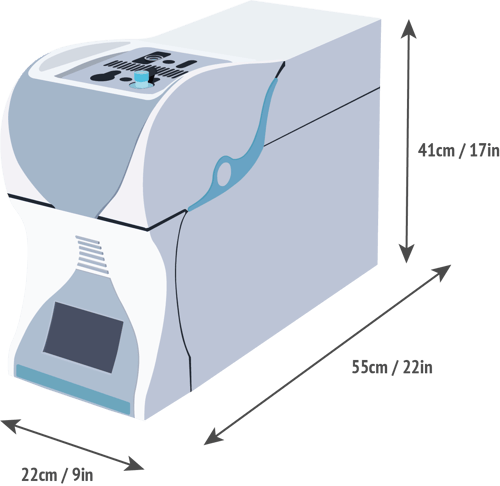
45 cm (H) × 22 cm (W) × 57 cm (D)
Weight
18 kg
Power supply
1200 VA
100-240 V, 50–60 Hz
Oven heating rates (conventional and fast modes)
35–150 °C: up to 50 °C/min 120–240 °C: up to 30 °C/min 240–300 °C: up to 20 °C/min 300–350 °C: up to 5 °C/min
Oven design
Flow-through oven with integrated heat exchanger
Column support
Compatible with standard capillary columns from most manufacturers. Packed columns also supported. Ultra-fast mode requires deactivated stainless steel columns.
Injection
Temperature-programmable split/splitless injector. Temperature range: ambient +20 °C to 600 °C.
Detector configuration
Single-channel system
One detector per instrument
Software control
Ellution chromatography software
Ready to see the 500 Series GC in your workflow?
If throughput, bench space, or running costs are factors in your next GC decision, we can work through the options with you.
500 Series Brochure
A detailed overview of the 500 Series GC, including specifications, operating modes, and configuration options.

Frequently Asked Questions
-
Which industries use the 500 Series GC?
The 500 Series GC is used in pharmaceutical quality control, cannabis and hemp testing, food and drink analysis, forensic science, and industrial process laboratories. The common thread is the need for higher sample throughput or faster turnaround times than a conventional GC can deliver. In pharmaceutical QC, it supports high-volume batch testing. In cannabis testing, it handles the multiple analyses required per sample efficiently. In forensic and industrial environments, faster cycle times reduce bottlenecks in time-sensitive workflows.
-
What is the difference between fast and ultra-fast mode?
Fast mode uses the air-blown oven with shorter, narrower columns and higher temperature ramp rates than conventional analysis. Ultra-fast mode bypasses the oven entirely. An electrical current heats the column directly, which allows much faster temperature ramping and significantly shorter cool-down times between runs. Analysis times in ultra-fast mode can be as short as 5 minutes, compared to 20 to 30 minutes for a typical conventional GC run.
-
How does the 500 Series GC compare to the 200 Series?
The 200 Series and 500 Series serve different analytical needs. The 200 Series is built for routine, single-method testing where compact size, simplicity, and ease of use are the priority. The 500 Series is built for labs where throughput, speed, or method flexibility are the deciding factors. If your workflow involves straightforward routine testing with established methods and moderate sample volumes, the 200 Series is likely the right fit. If you need faster run times, higher daily sample volumes, or the ability to run multiple methods on one instrument, the 500 Series is the stronger choice.
-
Can I use my existing columns and methods on the 500 Series?
In conventional and fast modes, yes. The 500 Series takes standard capillary columns from most manufacturers and runs existing GC methods without modification. Ultra-fast mode requires deactivated stainless steel columns, which are now available for most common applications. If you are transferring methods from an existing instrument, Ellutia can advise on compatibility and any adjustments needed for fast or ultra-fast operation.
-
Is the 500 Series GC suitable for regulated or compliance-driven work?
Yes. The 500 Series GC is operated using Ellution chromatography software, which supports CFR-compliant data handling. This makes it suitable for use in regulated laboratory environments including pharmaceutical quality control and food safety testing, where structured data management and audit trails are required. Method validation and system suitability requirements should be assessed against the specific regulatory framework in use.
-
What sample introduction options are available?
The 500 Series GC is fitted with a temperature-programmable split/splitless injector as standard. The injector reaches up to 600°C and ramps at up to 720°C/min with 10 programmable ramps, giving precise control over sample introduction conditions. The system is compatible with Ellutia autosamplers for liquid, headspace, and related automated sample introduction. Autosampler configuration depends on the sample type, matrix, and level of automation required and should be discussed as part of system setup.
-
What software does the 500 Series GC use and is it included?
The 500 Series GC is controlled using Ellution, Ellutia's chromatography data station developed in conjunction with DataApex. Ellution is included with the system and handles instrument control, data acquisition, and results processing from a single interface. It supports CFR-compliant data handling, connects to a wide range of data acquisition hardware, and can control up to four instruments from a single workstation. Optional extensions are available for specific analytical methodologies.
-
How does the 500 Series affect running costs?
The flow-through oven recovers heat via the built-in exchanger, reducing energy use compared to a conventional oven. The 500 Series draws 1,200 VA against 2,950 VA for a typical conventional GC — less than half the power consumption. In ultra-fast mode, only the column is heated rather than the full oven chamber, reducing energy consumption further. For labs running high sample volumes, the combination of lower energy use and faster cycle times improves the cost per analysis over time.
-
How does the size compare to a conventional GC?
The 500 Series is 22 cm wide and weighs 18 kg. A conventional GC typically measures around 58 cm wide and weighs 45 kg. Multiple 500 Series units can sit on the bench space a single conventional instrument would occupy. For labs considering adding throughput capacity without expanding their footprint, this size difference is often a deciding factor.
-
Is the interface suitable for less experienced operators?
Yes. The interface includes a step-by-step guide for common tasks including column changes and routine maintenance, so day-to-day upkeep does not depend on specialist GC knowledge. For labs with mixed experience levels or high staff turnover, this reduces training time and the risk of operator error during routine procedures.