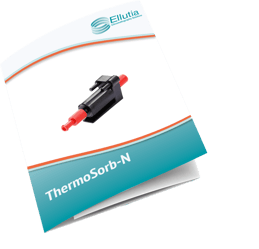
ThermoSorb-N
Reliable airborne nitrosamine sampling. No false positives. No sample loss.
Nitrosamines are potent carcinogens. Standard sampling methods produce unreliable results. The ThermoSorb-N collects airborne nitrosamines accurately — by design.

Results that reflect reality
Other sorbents can generate nitrosamines during collection itself. The ThermoSorb-N prevents that, so your results show what was in the air and not what happened inside the sampler.

No sample loss
Solid sorbent construction and opaque housing prevent UV degradation and desorption over time or temperature.

Ready for the field
Clip attaches to most work clothes. End caps store on the cartridge itself. No searching required when you need to seal a sample.
The problem with standard airborne nitrosamine sampling
When you use solid sorbents to collect airborne nitrosamines, nitrogen oxides can react with amines in the sampler and generate nitrosamines that weren't there. That's a false positive.
Wet traps have the opposite problem. Nitrosamines desorb over time and degrade with temperature changes. By the time the sample reaches the lab, some of it is gone. That's a false negative.
Either way, the number you get does not reflect what was in the air.
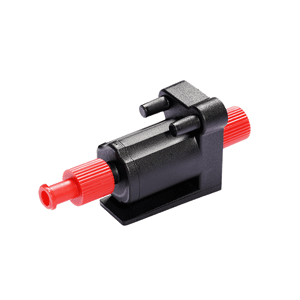
The ThermoSorb-N was designed to solve both problems. An integrated artifact trap combines an amine-trapping agent with a nitrosation inhibitor, blocking in-situ formation before it starts. Opaque plastic housing and solid sorbent materials prevent UV degradation and desorption. The sample you collect is the sample you analyse.
See how it works
This short overview explains what the ThermoSorb-N does, why other methods fall short, and what makes this approach different.
Zero artifact formation across every test.
The ThermoSorb-N was tested against six common sorbents: activated charcoal, activated alumina, Florisil, silica gel, Tenax GC, and wet traps. 100 litres of air containing 1 ppm NO and 1 ppm NO₂ were passed through each, with 50 µg of five amine standards pre-loaded.
Every other sorbent showed measurable nitrosamine formation. The ThermoSorb-N showed none.
| Sorbent | NDMA | NDPA | NPIP | NPYR | NMOR |
|---|---|---|---|---|---|
|
Activated Charcoal
|
5.9
|
1.7
|
5.0
|
1.5
|
7.9
|
|
Activated Alumina
|
1.2
|
0.1
|
0.22
|
0.1
|
8.9
|
|
Florisil
|
0.59
|
ND
|
0.2
|
0.21
|
0.1
|
|
Silica Gel
|
1.9
|
ND
|
0.56
|
0.58
|
9.0
|
|
Tenax GC
|
0.17
|
0.45
|
3.8
|
1.3
|
15.5
|
|
Thermosorb-N |
ND
|
ND
|
ND
|
ND
|
ND
|
|
1N KOH
|
ND
|
ND
|
ND
|
ND
|
ND
|
|
pH 4.5 Ascorbic Acid
|
ND
|
ND
|
ND
|
ND
|
ND
|
*ND = Not Detected. Results from in-situ formation test: 100L air, 1ppm NO + 1ppm NO₂ at 2L/min through sorbents spiked with 50µg each of five amine standards.*
Of the methods that were free from artifact formation, ThermoSorb-N was the only one that also retained all collected nitrosamines quantitatively. Wet traps showed sample loss over both time and temperature. No sample loss was observed with the ThermoSorb-N.
The ThermoSorb-N also shows excellent linearity and precision across a wide concentration range. Recovery values for seven common volatile nitrosamines ranged from 89% to 113% across concentrations from 25 ng to 1000 ng spiked.
Trusted by occupational hygienists and safety teams worldwide.
The ThermoSorb-N is used across rubber processing, metalworking, automotive manufacturing, and chemical production environments. It ships worldwide and is the sampling method of choice for organisations that need reliable airborne nitrosamine data.




How to use
Sampling in the field
This video walks through how to use the ThermoSorb-N in different environments and how to collect a sample correctly. From removing it from the foil pouch to sealing it after the sampling period.
Extracting and analysing your sample
Once sampling is complete, analysis is straightforward. This video covers the solvent back-flushing technique used to elute the sample, and how to run the analysis using a gas chromatograph connected to the Ellutia 800 Series TEA.
Twelve steps from pouch to result.
The ThermoSorb-N is designed to make sampling as straightforward as possible. Here's the full process from start to finish.
-
Remove air sampler from the foil pouch.
-
Label air sampler with the supplied numbered label.
-
Remove the two air sampler sealing caps and store on the posts on the sampler.
-
Attach air sampler to the sampling pump.
-
Calibrate the pump.
-
Record the appropriate data on the data log label.
-
Attach the air sampler near the breathing zone.
-
After the sampling period, remove the air sampler.
-
Replace the two sealing caps.
-
Record the appropriate data.
-
Place air sampler in the foil pouch and re-seal.
-
Place sealed pouch in a mailer and submit for analysis.
Where the ThermoSorb-N is used
The ThermoSorb-N is used by occupational hygienists, health and safety teams, and analytical laboratories in rubber processing, metalworking, automotive manufacturing, and chemical production environments.
Personal monitoring
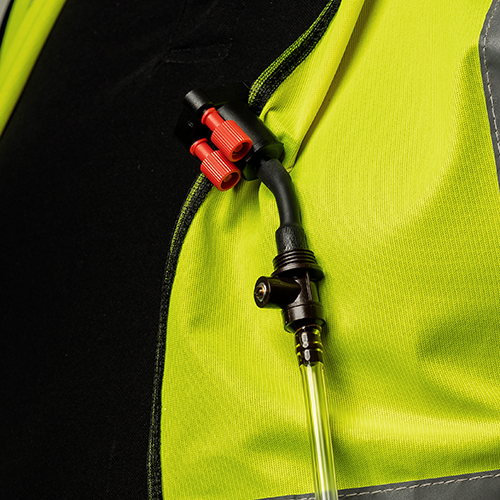
Workers in environments where nitrosamine exposure is a risk — manufacturing, rubber processing, metalworking — can wear the ThermoSorb-N throughout a shift. The integral clip attaches to a pocket or lapel and stays secure during normal working activity.
Workplace monitoring
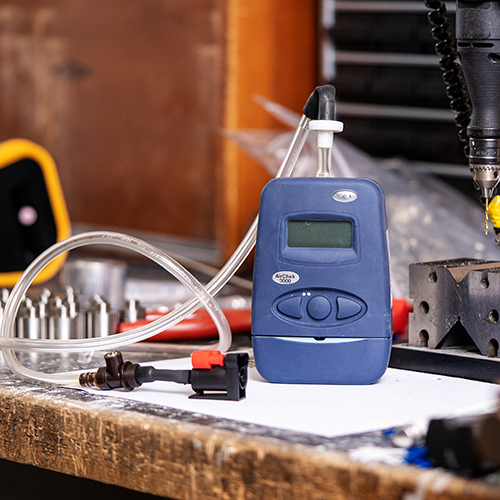
Fixed-point monitoring in industrial environments. A second cartridge can be attached "piggyback" style if unusually high concentrations of N-nitroso compounds are suspected.
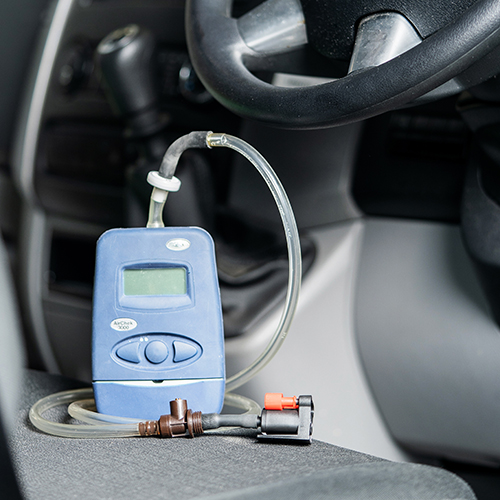
Vehicle interiors
Airborne nitrosamine levels in enclosed vehicle environments can be measured using the same collection method, with the sampler positioned near the occupant breathing zone.
Complete the workflow with the 800 Series TEA
After collecting and eluting the sample, analysis is fast and specific. The 800 Series TEA responds only to N-nitroso compounds, ignoring everything else in the eluate. Results at part-per-billion levels take minutes.
For laboratories that also need total nitrosamine content without compound separation, the ATNA automates the full screening workflow.
Order today. Ship worldwide.
Worldwide shipping on all orders.
Download the ThermoSorb-N brochure