Nitrosamine Testing in Cosmetics
Your formulation may be compliant today. Storage could change that.
Nitrosamines can form in cosmetic and personal care products after manufacture. The amine-based ingredients that give your products their texture, lather, and stability are often the same ones that react with nitrosating agents to produce them. A product that tests clean on the production line may not stay that way.
Under EU legislation, cosmetics and personal care products are regulated under the same framework. This includes shampoos, conditioners, moisturisers, body lotions, and similar formulations. EU Cosmetics Regulation EC 1223/2009 sets a limit of 50 μg/kg for nitrosamines across all of them. Demonstrating compliance means testing across the product lifecycle, not just at batch release.
Formation starts with your formulation
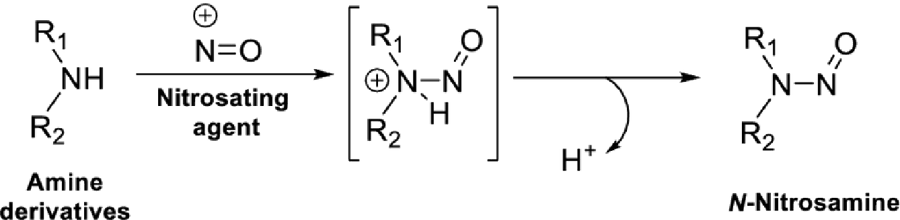
Diethanolamine (DEA) and triethanolamine (TEA) are in more cosmetic formulations than most manufacturers realise. They appear in shampoos, conditioners, moisturisers, and lotions as emulsifiers, pH adjusters, and foam stabilisers. They are also secondary amines.
When a secondary amine meets a nitrosating agent, the conditions for nitrosamine formation are in place. Nitrosating agents can enter a product through preservatives, through contaminated raw materials, or through nitrite present in process water.
Heat accelerates the reaction. So does low pH, extended storage, and contact with certain packaging materials. A product that passes testing at manufacture may generate nitrosamines over time, particularly if storage conditions vary across the supply chain.
The nitrosamine of most concern in cosmetics is N-nitrosodiethanolamine, known as NDELA. It forms directly from DEA under nitrosating conditions and is classified as a probable human carcinogen. EU regulators have issued product safety alerts for NDELA concentrations ranging from 52 μg/kg to over 56,000 μg/kg in cosmetic products, a wide range that reflects how unpredictable formation can be.
NDELA is not the only nitrosamine of concern. Any secondary amine in a formulation is a potential precursor. The challenge is that you may not know which nitrosamines are present, or whether they are forming over time, without a method capable of detecting all of them.
The 50 μg/kg limit and what it means for you
EU Cosmetics Regulation EC 1223/2009 sets a limit of 50 μg/kg for total nitrosamines in cosmetic products. Products containing nitrosamines above trace levels that are technically unavoidable under good manufacturing practice are considered non-compliant. The same limit applies to products placed on the UK market under equivalent domestic legislation.
The regulation does not mandate a single analytical method. It sets the limit, and the responsibility to demonstrate compliance rests with the manufacturer or responsible person through a validated testing approach.
The May 2026 CMR amendments are not the end of this. The EU has been tightening cosmetic ingredient restrictions consistently for three years. Nitrosamines are on the list and they are staying there.
Testing for nitrosamines
Total Analysis: ATNC
ATNC, or Apparent Total Nitrosamine Content, is the recognised analytical method for demonstrating compliance with the 50 μg/kg limit under EC 1223/2009. It measures the combined nitrosamine content of a sample through a controlled chemical reaction that releases the N=O group common to all nitrosamines, then detects the resulting nitric oxide using a thermal energy analyser. The output is a single value for total nitrosamine content.
This approach does not identify which nitrosamines are present. It confirms if the total amount falls above or below the 50 μg/kg limit. For routine compliance testing and incoming raw material screening, it is the fastest way to establish if nitrosamine activity is present at all. A sample that falls below the limit cannot contain any individual nitrosamine above it.
Our webinar Detecting Unexpected Nitrosamine goes into more detail. You can watch it on demand here.
Targeted analysis: GC-TEA
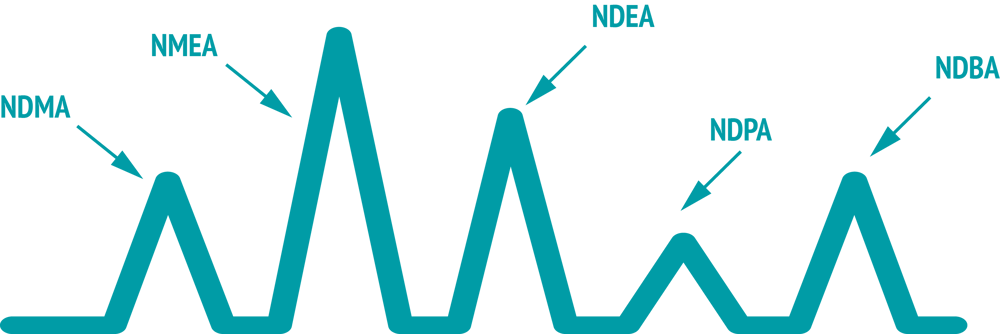
When a sample shows elevated total nitrosamine content, or when individual nitrosamine identification is required, gas chromatography coupled with a thermal energy analyser provides compound-specific results. The GC separates individual nitrosamines as they travel through the column. The TEA responds specifically to the N-O bond, producing distinct peaks for each compound present.
The TEA's specificity is an advantage in complex cosmetic matrices. Many co-eluting compounds produce no TEA signal, which means cleaner chromatograms and more reliable quantification. The detector responds to nitrosamines it has not been specifically calibrated for, so unexpected compounds appear as distinct peaks rather than going undetected.
For most cosmetics manufacturers, ATNC analysis covers routine compliance testing. GC-TEA is used when speciated data is needed: during investigation, formulation review, or when regulators request compound-specific confirmation.
The cost of waiting for results
Many cosmetics manufacturers currently send samples to contract research organisations for nitrosamine testing. The results are accurate. The process is not. Turnaround times of several days to several weeks are common. Reformulation decisions, batch release, and supplier qualification all wait on external results.
The cost accumulates quickly. Testing fees, repeat analyses, and held inventory all add up. And that is before you factor in the decisions that stalled while you waited for results.
An in-house ATNC system changes the workflow. Samples can be run the same day they are collected. Results are available before the batch moves forward. If a result comes back high, investigation begins immediately rather than days later.
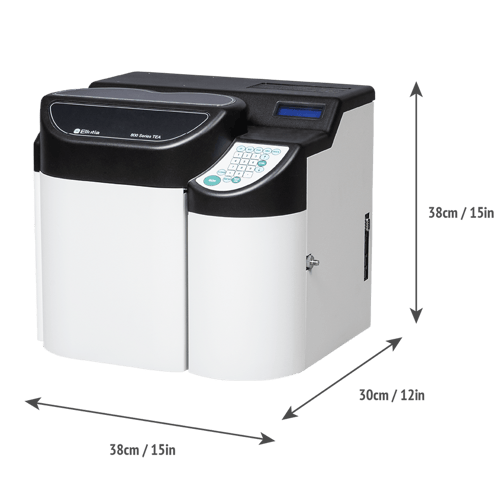
The TEA detector at the heart of Ellutia's ATNC systems achieves detection limits below 1 ppb in cosmetic matrices, well within the sensitivity required for the 50 μg/kg regulatory limit. The system can be configured for manual or automated analysis depending on sample volume and throughput. Automated configurations handle batches unattended, including overnight runs, which suits laboratories with high testing schedules.
Sample preparation varies by matrix but requires no specialist equipment beyond what most cosmetic laboratories already have. ATNC analysis is a recognised method under EC 1223/2009. The methodology is not new, and neither is the expectation to use it.
Trusted by cosmetics manufacturers and testing laboratories
The detector that only sees nitrosamines
Most analytical detectors respond to a broad range of compounds. The Thermal Energy Analyser does not. It responds specifically to the nitrogen-oxide bond, the N=O group present in every nitrosamine compound without exception. In a cosmetic matrix full of emulsifiers, preservatives, fragrance components, and pH adjusters, the TEA ignores all of them. It only fires when it finds a nitrosamine.
There is no interference from the surrounding matrix, no ambiguity about what produced the signal. And because the TEA responds to the bond rather than the molecule, it will detect a nitrosamine it has never encountered before. No compound-specific standards are required. If the N=O bond is present, the TEA finds it.
For total nitrosamine analysis, the TEA sits at the heart of Ellutia's ATNA system, producing a single value for all nitrosamines present in a sample. For targeted analysis, the same detector is coupled with a gas chromatograph in the GC-TEA, separating individual compounds and producing a distinct peak for each one.
Talk to our team about your application
A short meeting covers your specific application, your current testing setup, and what an in-house nitrosamine testing programme would look like for your laboratory. If you have questions about a specific cosmetic matrix or compliance requirement, we can work through those directly.
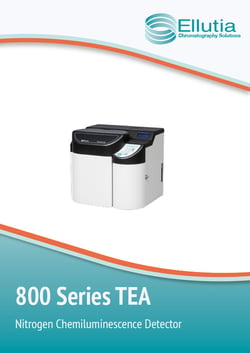
The TEA brochure
The 800 Series TEA brochure covers detector specifications, system configurations, and application data. Download it to share with your team or review technical details before a meeting.
Related resources
Nitrosamine Applications
A full overview of nitrosamine testing across industries, instruments, and applications. If you are building or reviewing a testing programme, this is the right place to start.
Nitrosamine Analysis Buyers Guide
Covers the difference between total and targeted nitrosamine testing, how each approach works, and which instruments are involved. A useful reference before a purchasing decision.
Webinars on Demand
Three recorded sessions on nitrosamine detection. Topics include detecting unexpected nitrosamines, targeted detection methods, and how the ATNA fits into a broader testing programme. Free to watch, no registration required.
Frequently Asked Questions
-
We use triethanolamine (TEA) as an ingredient. Does that mean our product is at risk?TEA is a secondary amine and one of the precursors most commonly linked to nitrosamine formation in cosmetics. Its presence in a formulation does not mean nitrosamines will form, but it does mean the conditions for formation can exist if nitrosating agents are also present. Products containing TEA, DEA, or other secondary amines should be assessed for nitrosamine risk and tested accordingly.
-
Our contract manufacturer handles testing. Is that sufficient for compliance?If the testing being carried out meets the requirements of EC 1223/2009 and uses a validated method capable of detecting nitrosamines at the 50 μg/kg limit, it can satisfy compliance requirements. Some manufacturers choose to bring testing in-house to gain more direct control over results, turnaround times, and the ability to test incoming raw materials before they enter production.
-
Can nitrosamines form in rinse-off products as well as leave-on?Yes. While leave-on products present a higher exposure risk due to prolonged skin contact, nitrosamines can form in rinse-off products if the formulation contains amine precursors and nitrosating agents. Both product types should be assessed for formation risk.
-
Which cosmetic product types are most commonly flagged in EU safety alerts for nitrosamines?NDELA has been detected across a wide range of product types including shampoos, conditioners, moisturisers, and body lotions. These products commonly contain DEA or TEA as functional ingredients. Cutting fluids and rubber-based cosmetic components have also been flagged. Cutting fluids and rubber-based cosmetic components have also been flagged. The range of affected product types reflects how widespread amine-based ingredients are across cosmetic formulations.
-
Is there a difference between EU and UK nitrosamine requirements for cosmetics?
The UK maintains equivalent requirements to the EU under its domestic cosmetics legislation, with the 50 μg/kg limit applying to products placed on the UK market. The regulatory frameworks are closely aligned but are maintained separately, and manufacturers selling into both markets should monitor each independently as they may diverge over time.