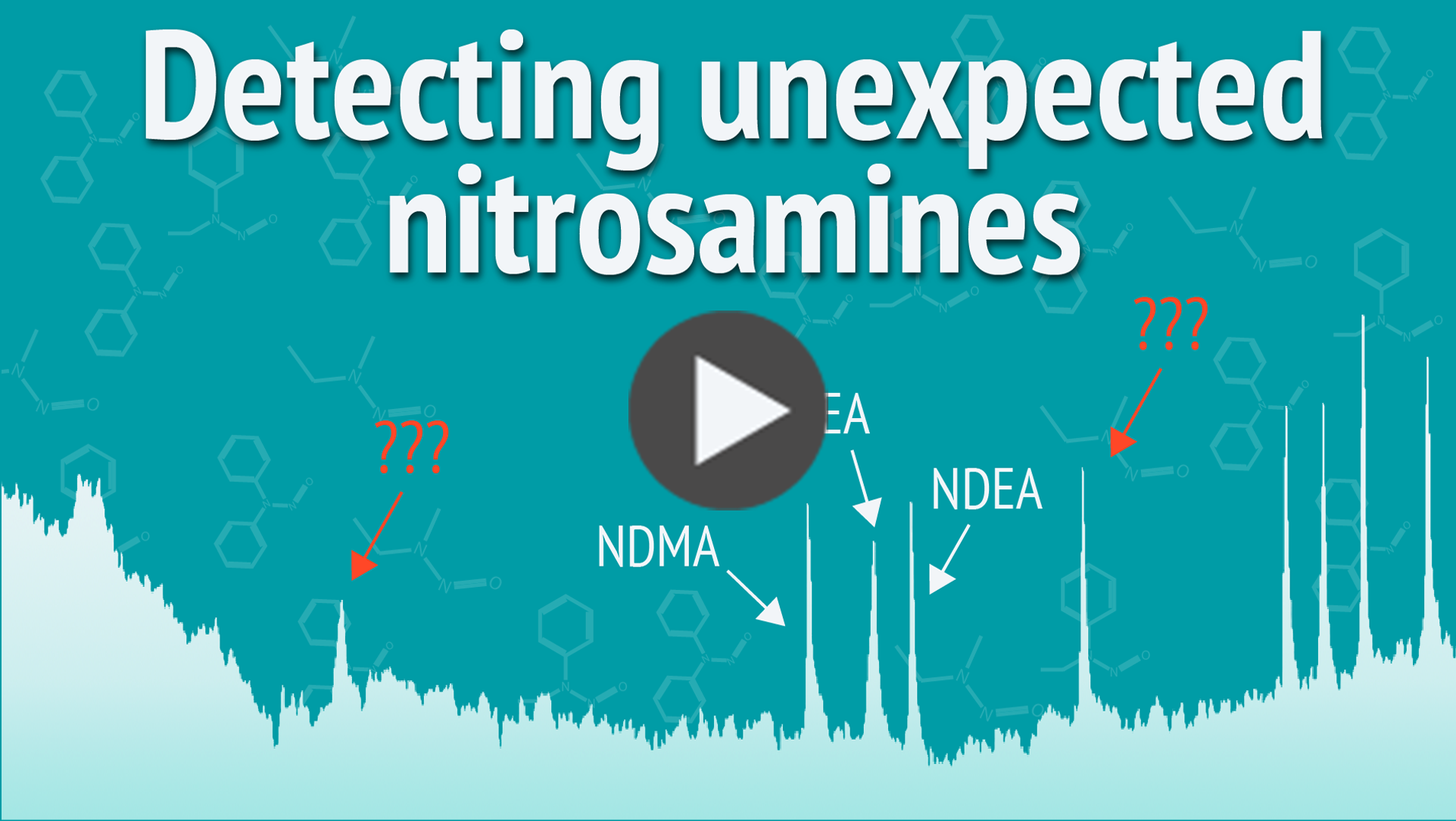
The ATNA measures the total amount of nitrosamines in a sample and reports a single value for the entire group. This includes known nitrosamines as well as those without standards or those that form unexpectedly during production or storage. It gives teams a fast indication of when further targeted testing may be needed.
It does not require individual compound standards, making it well suited to early screening and investigation work.
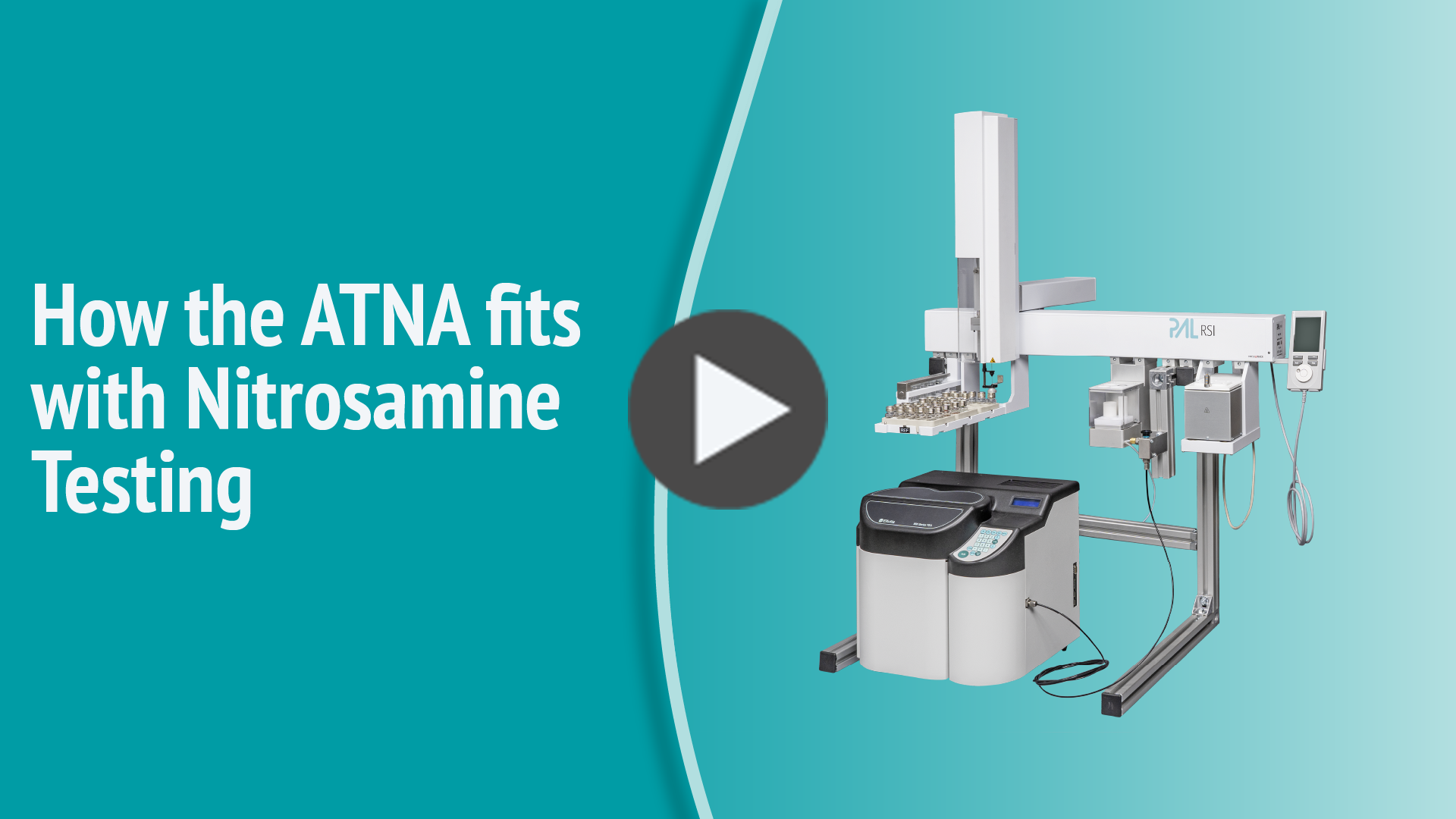
ATNA: an introduction
An introduction to the ATNA, showing how automated total nitrosamine screening works and where it fits into routine laboratory testing.
How automated total nitrosamine testing works
The ATNA measures total nitrosamines by heating the sample to release nitric oxide and then detecting this gas with a nitrogen-selective analyser. All nitrosamines contribute to the signal, which produces a single total value. This makes it straightforward to see when nitrosamine formation is occurring, even if unexpected compounds are present. It provides a quick way to decide whether further investigation is required.
Samples are placed in sealed headspace vials and loaded into the autosampler. Each vial is mixed and heated to release nitric oxide from any nitrosamines present.
Heating breaks the nitrosamine structure and produces nitric oxide in the headspace. This approach allows all nitrosamines to be measured together, including those without available standards.
The vapour is drawn into a thermal energy analyser, which responds only to the nitric oxide group. This selectivity removes background interference and provides a clear total nitrosamine value.
The final output is a single value that reflects the total amount of nitrosamines in the sample. This gives a quick indication of whether formation is taking place and whether targeted analysis should be considered.
From tablet to chromatogram
A step by step demonstration of the screening process, from sample preparation to total nitrosamine measurement.
Trusted in cosmetics compliance and pharmaceutical screening
The ATNA is used by cosmetics manufacturers demonstrating compliance with the 50 μg/kg threshold under EU Cosmetics Regulation EC 1223/2009, and by pharmaceutical quality teams as a screening tool ahead of targeted analysis under ICH M7. As a total nitrosamine screening system, it identifies when formation is occurring and when further speciated analysis is needed.
Built for routine, high-volume testing
Sensitivity
Detects total nitrosamines at low ppb levels. Sensitivity is sufficient for compliance screening against limits such as the 50 μg/kg threshold under EU Cosmetics Regulation EC 1223/2009.
Capacity
Holds 120 headspace vials, making it suitable for batch screening and longer unattended sequences.
Throughput
Processes up to 10 samples per hour, giving teams quick access to clear screening results.
Footprint
Fits on a standard laboratory bench. Requires a connection to an inert gas supply. No specialist infrastructure needed beyond what most analytical laboratories already have.
Specifications
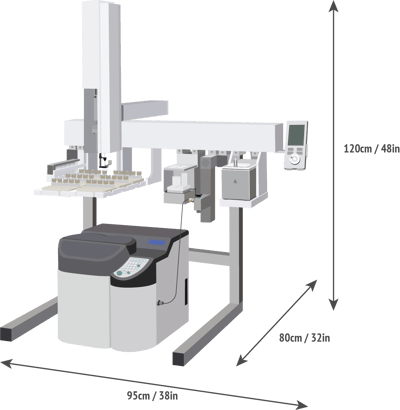
The ATNA combines the 800 Series TEA with an automated PAL RSI headspace autosampler in a single integrated system.
Dimensions 95 cm (W) × 80 cm (D) × 120 cm (H)
Weight 30 kg
Sensitivity < 1 ppb total nitrosamines
Capacity 120 headspace vials
Throughput Up to 10 samples per hour
Detection 800 Series Thermal Energy Analyser (TEA)
Selectivity gN/gC > 10⁷
Operation Fully automated, including unattended overnight runs
Ready to see the ATNA in your workflow?
We can walk through your sample types, your current screening setup, and what an ATNA configuration would look like for your laboratory. If you have questions about a specific matrix or regulatory requirement, bring them to the conversation.
The ATNA is used primarily in pharmaceutical and cosmetics manufacturing, where regulatory requirements for nitrosamine testing have increased significantly since 2018. In cosmetics, it is used to demonstrate compliance with the 50 μg/kg total nitrosamine limit under EU Cosmetics Regulation EC 1223/2009. In pharmaceuticals, it is used as a screening tool to identify when nitrosamine formation is occurring ahead of targeted speciated analysis under ICH M7. It is also used in food contact materials, rubber, and other industries where total nitrosamine content is a relevant safety parameter.
The ATNA measures the total amount of nitrosamines in a sample and reports a single combined value expressed in ppb. This includes known nitrosamines as well as those that form unexpectedly during production or storage, and compounds for which no individual standards exist. The system achieves sensitivity below 1 ppb, which is sufficient for screening against regulatory limits such as the 50 μg/kg threshold under EU Cosmetics Regulation EC 1223/2009.
The ATNA automates the ATNC (Apparent Total Nitrosamine Content) method. ATNC is the recognised analytical approach for total nitrosamine screening, used across cosmetics, pharmaceuticals, and related industries to assess overall nitrosamine formation risk. The method works by chemically cleaving nitrosamines to release nitric oxide, which is then detected by the TEA. The ATNA handles this entire process automatically, including sample heating, NO release, and detection, removing the need for manual steps and allowing high-volume batch runs.
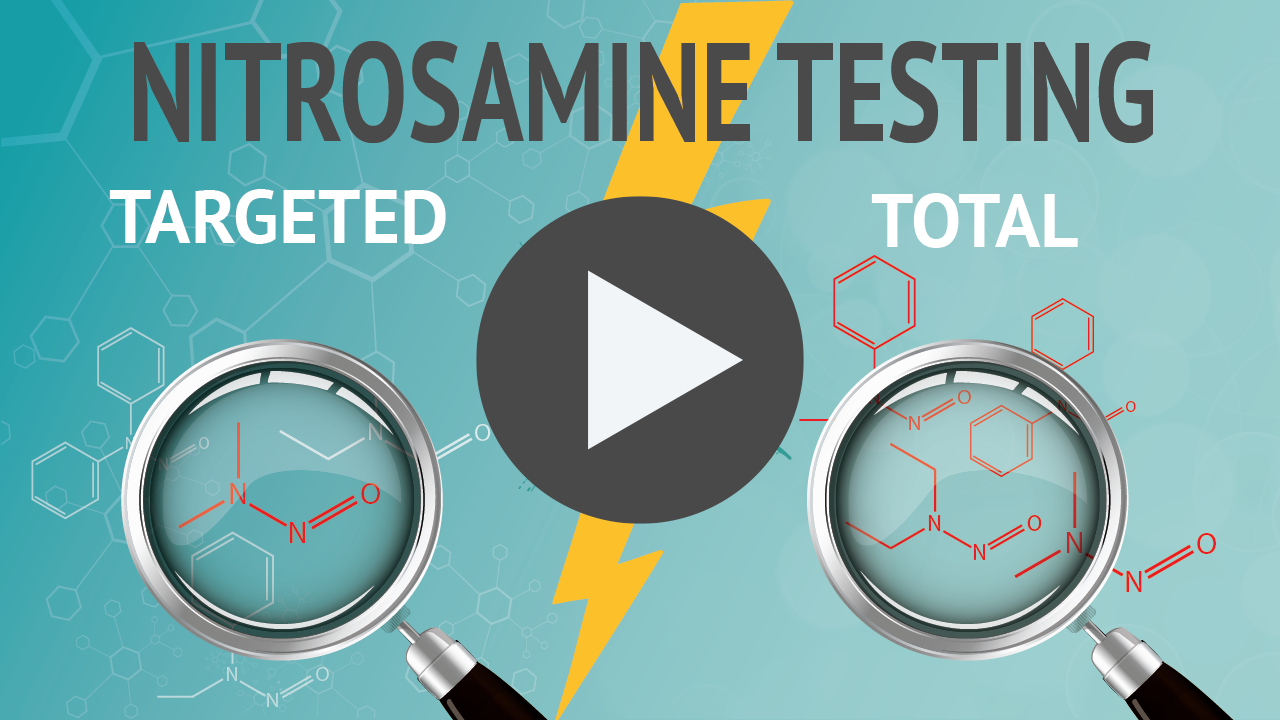
The ATNA and GC-TEA both use the 800 Series Thermal Energy Analyser as their detector, but they answer different analytical questions. The ATNA measures total nitrosamine content and reports a single combined value for all nitrosamines in the sample. It does not identify individual compounds. GC-TEA couples the TEA with a gas chromatograph, separating compounds before detection so that individual nitrosamines such as NDMA, NDEA, and NDELA can be identified and quantified separately. The two systems are complementary. The ATNA is typically used for screening; GC-TEA is used for targeted speciated analysis when the screening result indicates formation is present.
No. The ATNA is designed for total screening rather than compound identification. It reports a single value for all nitrosamines present in the sample, including unknown or unexpected compounds. When a total nitrosamine result indicates formation is occurring, targeted GC-TEA or LC-MS methods can then be used to identify and quantify individual compounds. This two-stage approach is the recommended workflow in both cosmetics and pharmaceutical testing environments.
The ATNA is used as the first step in a two-stage screening workflow. It provides a fast total nitrosamine value that indicates whether formation is occurring. When a sample exceeds the screening threshold, targeted GC-TEA or LC-MS analysis is used to identify and quantify the individual nitrosamines responsible. This approach focuses detailed analytical time on the samples that need it, reducing the overall burden on more resource-intensive speciated methods.
The ATNA is used with a wide range of sample types including solid dose pharmaceutical products, tablets, creams, lotions, shampoos, and other complex matrices. Samples are prepared in sealed headspace vials and loaded into the 120-vial autosampler. Sample preparation and handling depend on the matrix. Ellutia can advise on suitability before purchase.
Only one. The ATNA requires a single nitrosamine standard for calibration purposes, typically NDMA, though other nitrosamines can be used. Beyond that, no individual compound standards are needed. Once calibrated, the system detects all nitrosamines present in the sample, including unknown or unexpected compounds for which no reference standards exist. This is one of the key advantages of the ATNC approach. The response is not limited to compounds you have standards for.
Yes. The ATNA handles routine, high-volume screening with fully automated operation. It holds 120 headspace vials and runs unattended sequences, including overnight batches. With throughput of up to 10 samples per hour, a laboratory running overnight sequences can process a full tray of samples without operator input. For cosmetics manufacturers running compliance screening against the EU 50 μg/kg limit, or pharmaceutical teams managing routine formation risk assessment, the ATNA is designed to fit into existing laboratory workflows without specialist GC knowledge.
The ATNA processes up to 10 samples per hour. Once samples are loaded and the sequence is started, the system runs automatically without operator input. For laboratories running overnight batches, a full tray of 120 vials can be processed in a single unattended run, with results available the following morning. Actual throughput depends on method settings and sample matrix, but 10 samples per hour is the standard operating rate.