
Off-Flavour Detection in Beer
Application Note:
Identify acetaldehyde, ethyl acetate, and benzaldehyde at the compound level in a single on-site run.
Introduction
Off-flavour compounds in beer are measurable signs of fermentation and process faults. Acetaldehyde causes a green apple taste. Ethyl acetate produces a solvent character. Benzaldehyde gives a marzipan note. All three are detectable by GC-FID at concentrations below the sensory threshold, giving breweries a compound-specific result before a batch reaches packaging.
The Challenge
Why sensory evaluation alone cannot diagnose off-flavours in beer
A sensory panel can confirm that a fault is present. It cannot tell you which compound is responsible, at what concentration, or which stage of the process produced it.
Without a specific result, process correction is approximate. Knowing that acetaldehyde is elevated points to fermentation temperature, conditioning time, or yeast health. Knowing only that something tastes wrong gives you nowhere to start.
Sending samples to a contract laboratory provides the specificity sensory evaluation lacks, but turnaround times of several days can hold up a packaging decision. When the cost of a delayed batch runs into thousands, waiting is not a practical answer.
The Solution
How GC-FID measures off-flavour compounds in beer
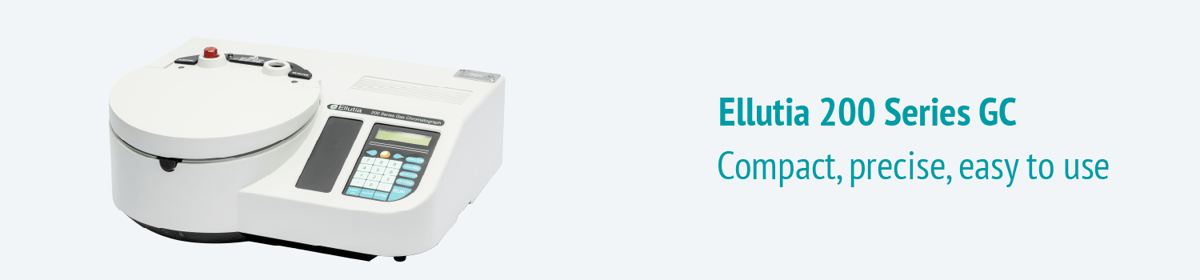
The Ellutia 200 Series GC with FID detection measures acetaldehyde, ethyl acetate, and benzaldehyde directly from a beer sample in a single analytical run. Each compound is identified and quantified independently. Common beer matrix components, including ethanol, do not co-elute with any of the three target compounds.
The instrument is compact and designed for routine use in a production or quality control environment. Results are available on-site, from the same instrument that handles ABV analysis and terpene profiling.

Method Overview
How the off-flavour analysis works
Sample preparation is straightforward. The beer sample is placed directly in a 2 mL vial and loaded into the instrument. No extraction, derivatisation, or specialist preparation is required. If the sample contains visible particulate matter or is heavily carbonated, it should be filtered or gently degassed before injection.
Once injected, the sample passes through an EL-5 capillary column. The column separates acetaldehyde, ethyl acetate, and benzaldehyde during the temperature programme, with each compound eluting at a distinct retention time. The flame ionisation detector (FID) measures the area of each peak, and the software calculates the concentration against the calibration curve.
A single run completes in under 10 minutes. Results are available immediately in the Ellution software.
GC Conditions
- Column: EL-5, 30m × 0.25mm × 0.25μm
- Initial temperature: 40°C (2 min hold)
- Temperature ramp: 20°C/min to 170°C (hold 1 min)
- Injector temperature: 250°C
- Injection volume: 0.5 μL
- Split flow: 20 mL/min
- FID temperature: 300°C
Results and Reliability
Calibration and spike recovery data for acetaldehyde, ethyl acetate, and benzaldehyde
Individual calibrations were run for all three compounds from 10 to 500 ppm. All three produced straight-line fits across the full range:
- Acetaldehyde: R² = 0.9998
- Ethyl acetate: R² = 0.9973
- Benzaldehyde: R² = 0.9961
Spike recoveries of 88.5% to 100% confirm reliable detection from real beer matrix. Each compound was spiked at 100 ppm and measured against a standard of the same concentration across lager, ale, and stout samples.
Lager, ale, and stout samples were run without spiking. No off-flavour compounds were detected in any sample. The method does not produce false positives in clean, well-fermented beer.

Learn More
Get the full method and results
If you’d like to see the full details behind this testing method, you can download the complete application note. The application note includes the calibration curves, spike recovery results, and chromatograms for separation and spiked samples, along with the exact GC conditions used in the analysis.
Download the full application note.
The application note includes the calibration curves, spike recovery results, and chromatograms for separation and spiked samples, along with the exact GC conditions used in the analysis.
Frequently Asked Questions
-
What are the main off-flavour compounds in beer?The most commonly measured off-flavour compounds are acetaldehyde, ethyl acetate, and benzaldehyde. Acetaldehyde produces a green apple taste and forms during fermentation. Ethyl acetate has a solvent character and results from esterification of ethanol and acetic acid. Benzaldehyde gives a marzipan note and can arise from oxidative processes during storage or processing.
-
At what concentration do off-flavours become detectable in beer?Acetaldehyde is typically noticeable to drinkers at around 10 to 25 mg/L. Ethyl acetate becomes detectable at approximately 30 to 50 mg/L. Benzaldehyde has a lower sensory threshold. GC-FID can detect all three compounds below these levels, making early identification possible before a fault becomes organoleptic.
-
What is GC-FID and why is it used for off-flavour testing?Gas chromatography with flame ionisation detection (GC-FID) separates volatile compounds by their physical and chemical properties as they pass through a capillary column. FID measures the concentration of each compound as it elutes. It is well suited to off-flavour testing because it identifies and quantifies individual compounds independently, without interference from the surrounding beer matrix.
-
Can the same instrument test for ABV and hop terpenes?Yes. The Ellutia 200 Series GC and EL-5 column used for this method can also run ABV analysis and terpene profiling using different oven programmes. See the [Complete Beer Profiling application note] for all three methods on a single instrument.