Terpene Profiling in Beer
Application Note:
Identify and quantify 20 hop terpene compounds in a single 13-minute run.
Introduction
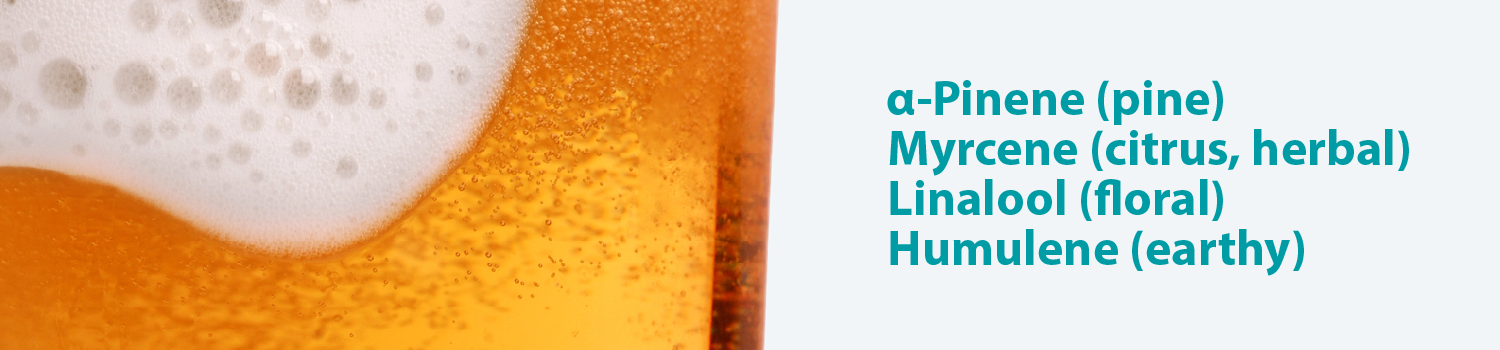
Hop terpenes define beer aroma. The balance of monoterpene hydrocarbons, sesquiterpenes, and sesquiterpene alcohols determines whether a beer carries citrus, pine, floral, or resinous character. GC-FID identifies and quantifies each compound independently, giving brewers a direct, compound-level terpene profile from a single analytical run.
The Challenge
Why terpene composition is difficult to track
Terpene composition varies between hop varieties, harvest years, and growing regions. It also changes during brewing. Terpenes are volatile, and the quantities that reach the finished beer depend on whirlpool temperature, dry-hop rate, contact time, and fermentation conditions.
Sensory evaluation can tell you whether hop character is present and at roughly what intensity. It cannot tell you which compounds are contributing, at what concentration, or whether a shift between batches reflects a change in the hops or a change in the process.
When two batches of the same recipe taste different, a terpene profile points directly to the cause. Without one, process correction is based on assumption.
The Solution
How GC-FID builds a hop terpene profile
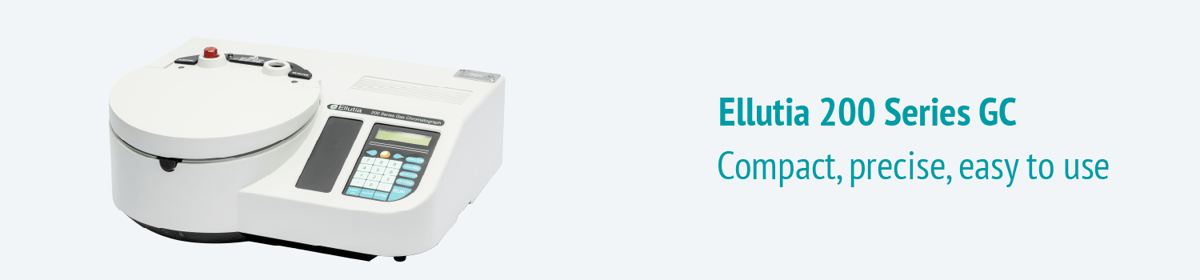
The Ellutia 200 Series GC with FID detection resolves 20 terpene peaks from a 19-component hop terpene standard in a single 13-minute run. The method covers monoterpene hydrocarbons through to sesquiterpene alcohols, the full range of commercially relevant hop-derived terpenes.
Each compound is identified and quantified from a hexane extract of the beer sample. Results are available on-site from the same instrument used for ABV analysis and off-flavour detection.
Method Overview
How hop terpene analysis works
Beer samples are extracted with hexane before injection. The extract is transferred to a 2 mL vial and loaded into the instrument. No specialist equipment beyond standard laboratory solvents is required. If the sample contains visible particulate matter, filter before extraction.
Once injected, the extract passes through an EL-5 capillary column. The temperature programme separates the terpene compounds, with each eluting at a distinct retention time across the 13-minute run. The flame ionisation detector (FID) measures each peak as it exits the column, and the Ellution software calculates the concentration against the calibration.
Cis- and trans-nerolidol are supplied together in the standard but produce two resolved peaks under these conditions, giving 20 peaks from 19 compounds.
GC Conditions
- Column: EL-5, 30m × 0.25mm × 0.25μm
- Initial temperature: 40°C (2 min hold)
- Temperature ramp: 20°C/min to 200°C (hold 4 min)
- Injector temperature: 250°C
- Injection volume: 0.5 μL
- Split flow: 20 mL/min
- FID temperature: 300°C
Terpene Components
The method covers the 19 compounds listed below. Each is resolved as a separate peak under these GC conditions.
| # | Compound | # | Compound |
|---|---|---|---|
|
1
|
α-Pinene
|
11
|
α-Terpinolene
|
|
2
|
Camphene
|
12
|
Linalool
|
|
3
|
β-Pinene
|
13
|
Isopulegol
|
|
4
|
Myrcene
|
14
|
Geraniol
|
|
5
|
3-Carene
|
15
|
Trans-caryophyllene
|
|
6
|
α-Terpinene
|
16
|
α-Humulene
|
|
7
|
4-Isopropyltoluene
|
17
|
Nerolidol (trans)*
|
|
8
|
D-Limonene
|
18
|
Nerolidol (cis)*
|
|
9
|
3,7-Dimethyl-1,3,6-octatriene
|
19
|
Guaiol
|
|
10
|
γ-Terpinene
|
20
|
Bisabolol
|
*Nerolidol cis and trans elute as two separate peaks from a single component in the standard.
Results and Reliability
Calibration and and recovery data for hop terpene analysis
α-Pinene was used as the reference compound for calibration. A seven-point series from 1 to 250 ppm produced a straight-line fit with R² = 0.9976. Full recovery was confirmed across all 19 terpene compounds.
Beer samples were extracted and run through the same procedure. The method returned a clean baseline with no interfering peaks at the terpene retention times, confirming that beer matrix components do not obscure any of the 20 terpene peaks. Hop-forward samples will return quantitative compound-by-compound results from the same run.

Learn More
Get the full method and results
If you’d like to see the full details behind this testing method, you can download the complete application note. The application note includes the calibration curves, spike recovery results, and chromatograms for separation and spiked samples, along with the exact GC conditions used in the analysis.
Download the full application note.
The application note includes the calibration curves, spike recovery results, and chromatograms for separation and spiked samples, along with the exact GC conditions used in the analysis.